
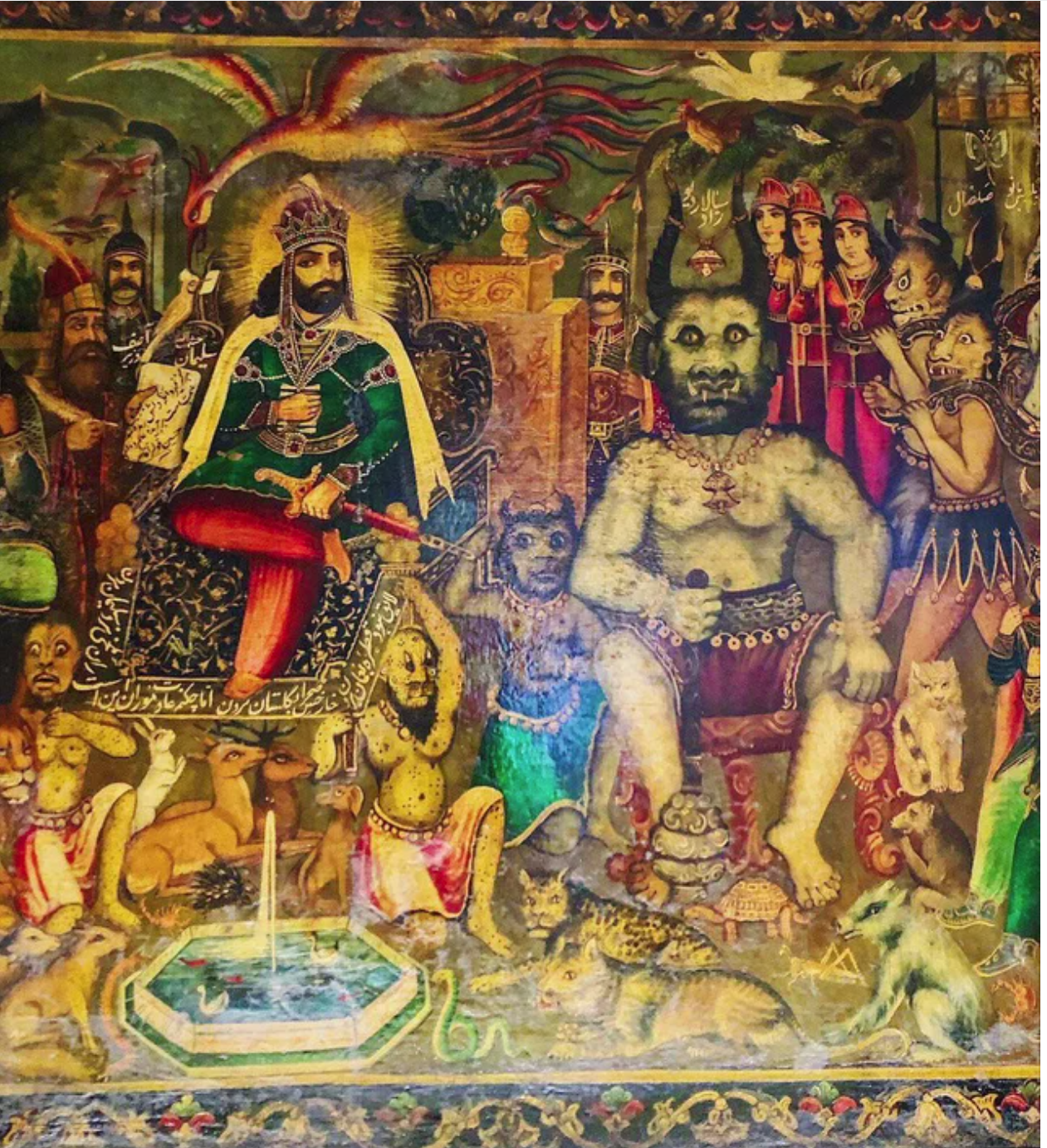
The identity of the Mad Arab in Necronomicon Alchemy has inspired both curiosity and speculation. Yet, as spiritualists our appreciation for the technology contained in the Necronomicon by Simon can only deepen through a thorough understanding of this sacred text.
Definition of Mad Arab
It is easy to determine that the Mad Arab is a supernatural entity as the term has a wonderous meaning in the Enochian language:
Enochian English Meaning
Mad God or Your God
Ar That
Ab Daughter of Light
Form the above Enochian Translation, we can easily see that the term Mad Arab means Your God that Daughter of Light. Another indication that the Mad Arab is an otherworldly entity, more specifically, a jinn can be determined by what is written about ‘wolves” in the Testimony of the Mad Arab.
The Meaning of Why “Wolves” Appear Frequently in the Mad Arab’s Testimony
Readers of the Necronomicon by Simon will note that the Mad Arab makes several references to “wolves”. The word wolves appears more than the names of any deity in the First Testimony:
“The wolves carry my name in their midnight speeches, and that quiet, subtle Voice is summoning me from afar. And a Voice much closer will shout into my ear with unholy impatience.”
“I built a fire at its foot to protect me from the wolves that wander in those regions and went to sleep, for it was night and I was far from my village, being Bet Durrabia.”
“Being about three hours from dawn, in the nineteenth of Shabatu, I was awakened by the howl of a dog, perhaps of a wolf, uncommonly loud and close at hand.”
“And even now I can hear the wolves howling in the mountains as they did that fateful night, and they are calling my name, and the names of Others.”
The Mad Arab not only writes about “wolves” frequently in the First Testimony but expresses a very deep fear of them. Why are there so many passages about wolves in Necronomicon by Simon may seem hard to understand. However, if, as the title of this article suggests, the Mad Arab is a jinn, then it would make sense. In the classic Islamic work entitled The Jinn and Human Sickness: Remedies in the Light of the Qu’raan and Sunnah by Dr. AbuTMundhir Khaleel ibn Ibraaheem Ameen states the following on page 34 of the said work in regard to the relationship between wolves and the jinn:
“There is also virtual consensus that the jinn are afraid of wolves, and they cannot appear in wolf form. Many people believe that wolves have power over the jinn when they appear in physical form, and are able to attack and devour them. They also believe that the jinn flee from the scent of wolves.”
Considering the Islamic belief concerning the relationship between the jinn and wolves, we can safely conclude that the Mad Arab himself was a jinn that put on the appearance of a man. Again we find in the Testimony of the Mad Arab Part II references to wolves as sealing the transcendental fate of the Mad Arab. Notice one of the opening statements of the Second Testimony of the Mad Arab:
“What God have I offended? What Goddess? What sacrifice have I failed to make? What Unknown Evil have I committed, that my going out should be thus accompanied by the fearful howlings of a hundred wolves?”
In an online article by Shannon Sinn titled Wolf Myths and Folklore From Around The World, we read:
“Wolves are also known to hunt and kill evil jinn spirits. There is an enmity between them. In Iraq, certain talismanic stones are believed to be jinn hiding from wolves. Some jinn have a wolf-like appearance – but they are not related, as wolves are their most bitter enemies. They are the good spirits that counter the jinn.”
One passage in the Necronomicon by Simon that may raise some questions as far as the identity of the Mad Arab, would be among the opening statements by the Mad Arab in the First Testimony, which reads:
“THIS IS THE TESTIMONY of all that I have seen, and all that I have learned, in those years that I have possessed the Three Seals of MASSHU. I have seen One Thousand-and-One moons, and surely this is enough for the span of a man’s life, though it is said the Prophets lived much longer.”
The words of the Mad Arab are quite interesting in terms of our present discussion. If one were to take a quick glance and this passage in the Necronomicon by Simon, it would appear that the Mad Arab is saying that his life is shorter than the “prophets” or the man during the Age of Noah. This is an important passage to consider as the jinn are said to live much longer than human beings. In the book Islam, Arabs, and the Intelligent World of the Jinn by Amira El-Zein, we read on pages 50 to 51 the following:
“Angels are immortal; their food and drink consist of praising God, while fiery jinn eat, drink, sleep, procreate, and die, after having lived extremely long lives that can extend for thousands of years…. (page 51) To illustrate the jinn’s extended lifespan The Tales of the Prophets include many stories in which some of the jinn encountered a number of the prophets long before Muhammad.”
Here we learn to things. First, that the Mad Arab’s words in regards to the “prophets” implies that he is a jinn, and has implication to the text cited in El-Zein’s work called The Tales of the Prophets, which describes some of the relationships between the prophets and the jinn. Secondly, we learn that the jinn have much longer lifespans than human beings. So how long did the Mad Arab live:
The Mad Arab speaks as if death is always looming, but this doesn’t mean that his life was short. In all actuality, he states that “I have seen One Thousand-and-One moons, and surely this is enough for the span of a man’s life, though it is said the Prophets lived much longer.” The Mad Arab is describing the length of time that he possessed the Three Seals of Masshu for One Thousand-and-One moons, the normal length of a human life but not his own. This point is further strengthened by what the Mad Arab states later in the First Testimony:
“But now, after One Thousand-and-One moons of the journey, the Maskim nip at my heels, the Rabishu pull at my hair,..”
Based on the Mad Arab’s words above, it is very clear that the One Thousand-and-One moons” had nothing to do with the length of his life, but the amount of time that the possessed the Three Seals of Masshu at the time of his writing of the Necronomicon.
How The Necronomicon Was Received by the Mad Arab
Another aspect in the First Testimony of the Mad Arab that points to the Mad Arab’s jinn identity can be found in the Mad Arab’s description of how he received the Necronomicon. The text reads:
“For this is the Book of the Dead, the Book of the Black Earth, that I have writ down at the peril of my life, exactly as I received it, on the planes of the IGIGI, the cruel celestial spirits from beyond the Wanderers of the Wastes.”
The “planes if the Igigi” is a reference to the zodiac. This means that the Mad Arab recovered the Necronomicon from the plane of fixed stars. Yet, he said that he did so at “the peril of his life.” Why?
If the Mad Arab was a human being, then it would be impossible to reach the realm of the zodiac, save astral projection, which doesn’t seem likely based on the context of other passages. However, if we were to understand the Mad Arab as a jinn, then his statement would seem to make more sense. In the Holy Qu’ran, Surah Al-Hajir, verses 17-18, we read:
“And We have guarded it (the heavens) from every accursed devil, except one who can snatch a hearing and he is pursued by a brightly burning flame.”
In Islam, it is said that the angels guard the heavens intensely, and meteors (shooting stars) attacked any Jinn who tried to listen. Thus, we find Mad Arab is a jinn who was able to gain the knowledge of the Necronomicon from the zodiacal planes that was later shared with the Chaldean nation. The Prophet Muhammad is noted as saying:
“They (the Jinn) would pass the information back down until it reaches the lips of a magician or fortune-teller. Sometimes a meteor would overtake them before they could pass it own. If they passed it on before being struck, they would add to it a hundred lies. (Sahih Al-Bakhari Hadith)
The reader should note that the Necronomicon Tradition doesn’t have the views about the Jinn that are found in the Islamic religion. In many cases, we are related to them and they are the guiding force behind the tradition. For example, we are told by the Mad Arab in the First Testimony that much of the information that he received was taught to him by an “emissary of the Elder Gods.” What does all of this mean?
The contents of the Mad Arab’s work is comprised of twelve books. Each book represents the knowledge of a specific zodiac sign and should be read and studied much like portions of the Tanakh is read by Jewish people during certain times of the year. We are blessed to have a book from the starry realms that was prepared for us by the Mad Arab.
 The Necronomicon Tradition
This is intriguing, but now I must ask: Which is The Mad Arab? A Djinn or Ishtar? In this article you have broken down the Mad Arab, quite eloquently, as Djinn, but in an older article you also said that the Mad Arab was in fact Ishtar. Is it one? The other? Both? Is one literal and the other metaphorical?
LikeLike